


Following up on our previous GMP blog “GMP Grade Ligand Binding and Potency Assays – Frequently Asked Questions”, this article explores GMP potency assays, including key technologies, development strategies, and real-world validation examples from Synexa Life Sciences.
Technologies Used in GMP Potency Assays
GMP potency assays, performed under Good Manufacturing Practice (GMP) regulations, are essential for evaluating the biological activity, binding capability, and overall performance of drug products. Synexa applies a suite of advanced analytical platforms to support these assays:
- Gyrolab (fluorescence): A microfluidic immunoassay system that uses fluorescence detection for high-sensitivity, low volume quantification. Ideal for rapid, automated ligand-binding assays and host cell protein analysis in GMP settings.
- MSD (electrochemiluminescence): Combines electrochemistry and luminescence to deliver highly sensitive and reproducible immunoassays. It is widely adopted in GMP environments for potency and binding assays.
- ELISA (enzymatic detection): A gold-standard enzymatic assay leveraging antibody-antigen interactions. Commonly used for binding, potency, and host cell protein analysis in GMP workflows.
- Delfia (time-resolved fluorescence): A fluorescence-based assay that reduces background signal using time-resolved detection. Delfia is used in GMP assays for high-sensitivity ligand-binding assays.
- SPR (surface plasmon resonance): A label-free technique that measures real-time interactions between molecules. In GMP assays, SPR is used to characterise binding kinetics of drug-target interactions.
- Gamma counting: A detection method used in radioligand binding assays to measure radioactive signals. Supports high-precision binding studies in GMP contexts.
These technologies enable precise, reproducible measurement of drug potency and binding characteristics, supporting regulatory compliance and product quality.
Types of GMP Assays
GMP-compliant assays are categorised by drug modality and intended use:
- Cell-based functional assays: Measure biological activity that mimics the drug’s mechanism of action, e.g. reporter gene assays, cell proliferation assays. Commonly used for monoclonal antibodies, cytokines and gene therapy products.
- Binding assays: Assess drug-target binding (receptor, antigen, ligand), e.g. utilising immunoassays, SPR or radioligand binding assays. Critical for demonstrating specificity and affinity.
- Enzymatic activity assays: Used when the drug acts as an enzyme or affects enzymatic reactions, e.g. substrate conversion assays, enzyme inhibition assays, or kinetic assays. Key for enzyme replacement therapy products or fusion proteins with enzymatic function.
- Immunological function assays: Quantify immune-related biological effects, e.g. cytokine release assays, neutralisation assays, T-cell activation assays or complement-dependent cytotoxicity (CDC). Applied to vaccines, immunotherapies or monoclonal antibodies.
- Gene expression assays: Measure downstream molecular effects of the drug, e.g. qPCR-based potency assays or reporter gene transcription assays used for gene therapy products.
- Biological production system-related assays: Include host cell protein analysis. Support process-related monitoring.
Assays should reflect the mechanism of action (MoA), be quantitative, robust and easily validated, preferably indicating stability issues. Multiple complementary assays, rather than a stand-alone potency assay, are often required to fully characterise potency and stability.
GMP Assay Development Strategy
Effective GMP assay development requires a tiered approach that combines multiple assay types to ensure reliability and regulatory compliance. A typical GMP Assay strategy may include:
- A primary cell-based functional assay
- A secondary binding assay (e.g. immunoassay or SPR)
- Supporting molecular or enzymatic assays
For monoclonal antibodies, this may extend to:
- Neutralisation or ligand blocking assays
- Fc-mediated effector function assays (e.g. ADCC, CDC, FcγR engagement)
Potency and stability can be influenced by factors such as glycosylation, oxidation, aggregation, or fragmentation, reinforcing the need for multi-assay approaches.
Case Study: GMP Method Development and Validation
Study Design
Drug: Genetically modified protein
Clinical Stage: Phase 1-2
Potency assay type: Competitive ligand binding assay in a streptavidin-coated microtiter plate format with electrochemiluminescence detection (MSD).
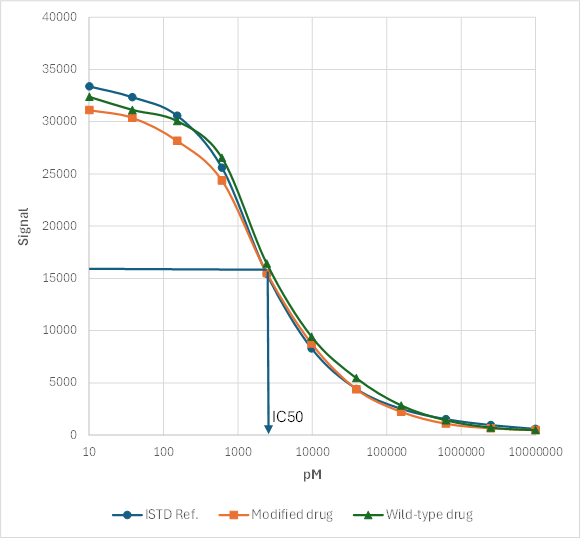
Assay design: A biotinylated wild-type drug molecule immobilised to the surface competes with a genetically modified soluble drug molecule for binding to the labelled target protein. The half-maximal inhibitory concentration (IC50) of the genetically modified test drug sample and the reference drug sample were compared, as well as the European Directorate for the Quality of Medicines & HealthCare (EDQM) international standard (ISTD) to calculate relative potency.
Inhibition curves
Method Development and Results
Method development: One IC50 value was calculated for each dilution series, including 11 concentrations. A four-parameter logistic (PL) unweighted function was used as a curve-fitting model. Specifications for potency limits (IC50) were set during assay development using various lots of international standard material and drug products.
Method validation: Accuracy, precision, specificity, IC50 confidence intervals, range, dilutional linearity, robustness/ruggedness, and system suitability controls were validated in accordance with ICH Q2 and ICH Q6a-b, as well as our internal SOPs. A total of six validation runs were performed for each sample in triplicate dilution series with two analysts. Accuracy (RE ±16%) and precision (CV ≤19%) of the reference standards were below the targeted criteria (25%).
Conclusions: All method validation parameters were met, and the potency GMP assay was successfully used for batch release and stability study samples reported relative to the international reference standard material. A Certificate of Analysis (CoA) was issued for acceptable sample runs.
GMP Assay FAQs
Q1: What are GMP potency assays?
GMP potency assays measure the biological activity of a drug product to ensure consistency, efficacy, and regulatory compliance.
Q2: Why are multiple assays required in GMP testing?
Multiple assays provide complementary data to fully reflect the drug’s mechanism of action and ensure reliable potency measurement.
Q3: What is the difference between binding assays and cell-based assays?
Binding assays measure interaction with targets, while cell-based assays assess functional biological activity.
Contact Synexa Life Sciences
The development and validation of GMP-grade ligand-binding and cell-based potency assays require a deep understanding of drug molecules and their modes of action, assay technologies, and regulatory expectations. Continuous performance monitoring using international standards or drug reference standards helps to ensure assay reliability throughout the whole product lifecycle.
Speak to our GMP assay experts to accelerate your drug development programme – contact our team at contactus@synexagroup.com.